Health Tech
B2B
Clinical Decision Support
Applied AI
Livr - A calm ML decision-support tool for liver disease in low-resource clinics
Livr - A calm ML decision-support tool for liver disease in low-resource clinics
Role
Role
Product &
UX Designer
Product &
UX Designer
Duration
Duration
3 Months
3 Months
Scope
Scope
UX Research
Interaction Design
Visual Design
ML Decision-Support UX
UX Research
Interaction Design
Visual Design
ML Decision-Support UX

Underlying ML model achieved
Underlying ML model achieved
~77%
~77%
accuracy in early disease severity detection
accuracy in early disease severity detection
Redesigned flow improved usability by
Redesigned flow improved usability by
~60%
~60%
during internal evaluation
during internal evaluation
Before
Before

After
After
This project started with an accurate ML prototype that failed to fit real clinical workflows.
This project started with an accurate ML prototype that failed to fit real clinical workflows.
——-
——-
My role was to redesign it into a practical decision-support tool that seamlessly supported clinical decision-making.
My role was to redesign it into a practical decision-support tool that seamlessly supported clinical decision-making.
Real-world constraints
Real-world constraints
Semi-urban clinics with intermittent connectivity and 5–10 minute consultations
Semi-urban clinics with intermittent connectivity and 5–10 minute consultations
Core gap
Core gap
The ML model was accurate, but clinicians couldn’t confidently interpret or act on the output
The ML model was accurate, but clinicians couldn’t confidently interpret or act on the output
Design focus
Design focus
Reframe prediction into a clear, defensible clinical decision-support experience
Reframe prediction into a clear, defensible clinical decision-support experience
The Problem
The Problem
——————————————
In 2022, our team built an accurate liver disease prediction model but the interface felt like a technical demo, not a clinical tool.
In 2022, our team built an accurate liver disease prediction model but the interface felt like a technical demo, not a clinical tool.
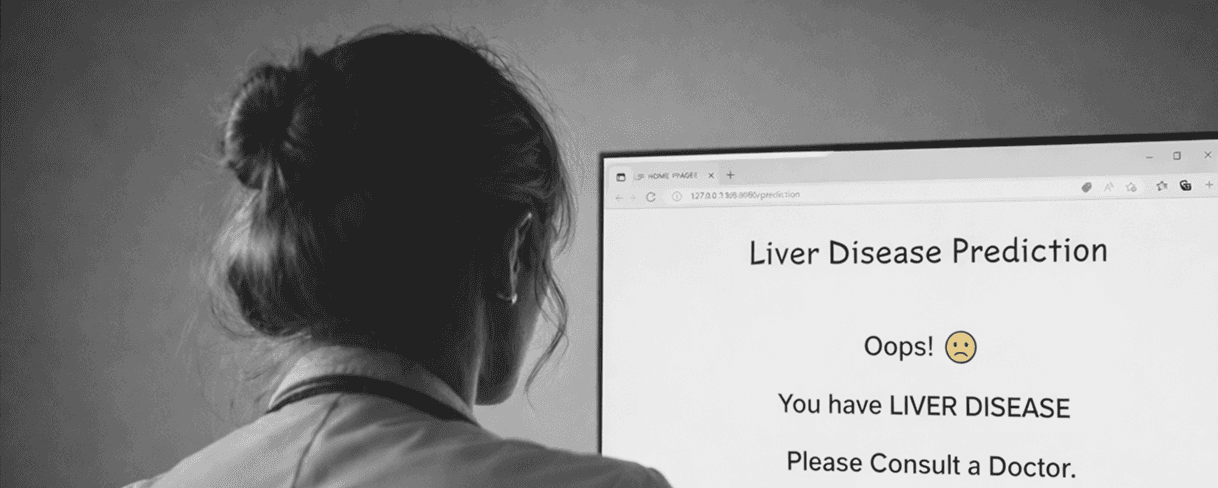
Binary “yes/no” predictions with no explanation
Binary “yes/no” predictions with no explanation
Long, unstructured data entry
Long, unstructured data entry
No guidance on what to do next
No guidance on what to do next
Designed for ideal infrastructure, not real clinics
Designed for ideal infrastructure, not real clinics
The model
worked.
The product
didn’t.
The model
worked.
The product
didn’t.
What synthesis revealed
What synthesis revealed
——————————————
When I reviewed the original prototype and mapped clinician feedback against real clinic workflows, a clear pattern emerged.
When I reviewed the original prototype and mapped clinician feedback against real clinic workflows, a clear pattern emerged.
Trust
Trust
Clinicians needed to understand why a patient was high risk
Clinicians needed to understand why a patient was high risk
Time
Time
Dense screens didn't survive a 5-minute consult
Dense screens didn't survive a 5-minute consult
Action
Action
Predictions without clear next steps weren’t actionable
Predictions without clear next steps weren’t actionable
The trade-off
The trade-off
I chose
clarity over
feature
breadth.
I chose
clarity over
feature
breadt.
I chose clarity over feature breadth.
Deferred
Deferred
EMR integrations
Advanced analytics
EMR integrations
Advanced analytics
Built now
01
Explanation-rich results
02
Guided data entry
03
Interpretation support
04
Embedded follow-up actions
Built now
01
01
Explanation-rich results
02
02
Guided data entry with real-time prediction
03
03
Interpretation support
04
04
Embedded follow-up actions
Designing for real clinical decisions means supporting uncertainty, not just prediction.
Designing for real clinical decisions means supporting uncertainty, not just prediction.
——————————————
Design tension
Design tension
Adding a chatbot was initially uncomfortable it risked feeling excessive but removing it revealed that clinicians had no place to resolve interpretation questions without leaving the flow.
Adding a chatbot was initially uncomfortable it risked feeling excessive but removing it revealed that clinicians had no place to resolve interpretation questions without leaving the flow.
One patient → a running caseload
01
01
Scan roster, filter by risk tier
Scan roster, filter by risk tier
→
02
02
Tap New Patient
Tap New Patient
→
03
03
Enter labs by clinical category
Enter labs by clinical category
Interpretation
Risk you can inspect, not just read
Every abnormal value shown against its normal range, each with a plain-language clinical read.
Action
A referral that gets kept
Doctor discovery, live scheduling, confirmed with a real reference ID.
Trust
The chatbot lives inside the evidence
Opens straight into the patient's own biomarker panel, no separate conversation needed.
Landing page
Outcome

Prediction became a decision, not an endpoint
Prediction became a decision, not an endpoint
Interpretation and follow-up were built directly into the flow.
Interpretation and follow-up were built directly into the flow.
The experience became one calm, linear path
The experience became one calm, linear path
Lower information density, fewer steps, and less cognitive load per screen.
Lower information density, fewer steps, and less cognitive load per screen.
Usability improved by ~60% in internal evaluations
Usability improved by ~60% in internal evaluations
Reframed the system from a research demo into practical clinical decision support.
Reframed the system from a research demo into practical clinical decision support.

In healthcare,
clarity isn’t a
feature.
It’s the product.
In healthcare,
clarity isn’t a
feature.
It’s the product.
Key takeaway
Key takeaway
What surprised me most was how quickly confidence returned once uncertainty was designed out.
What surprised me most was how quickly confidence returned once uncertainty was designed out.
Reference
Reference
Images from Unsplash.com and ChatGPT.
Images from Unsplash.com and ChatGPT.
*The underlying ML model was research-based and not deployed in production
*Redesign completed independently to explore how such a system could function as a real clinical decision-support tool.