B2B
SaaS
Fintech
Enterprise
Data-heavy
RISKLens: Financial Risk Assessment SaaS
Role
Product & UX Designer + Developer
Duration
2 Weeks
Tools
Figma
Claude AI
Vercel
Scope
UX Research
Interaction Design
Visual Design
Information Architecture
AI-Assisted Development
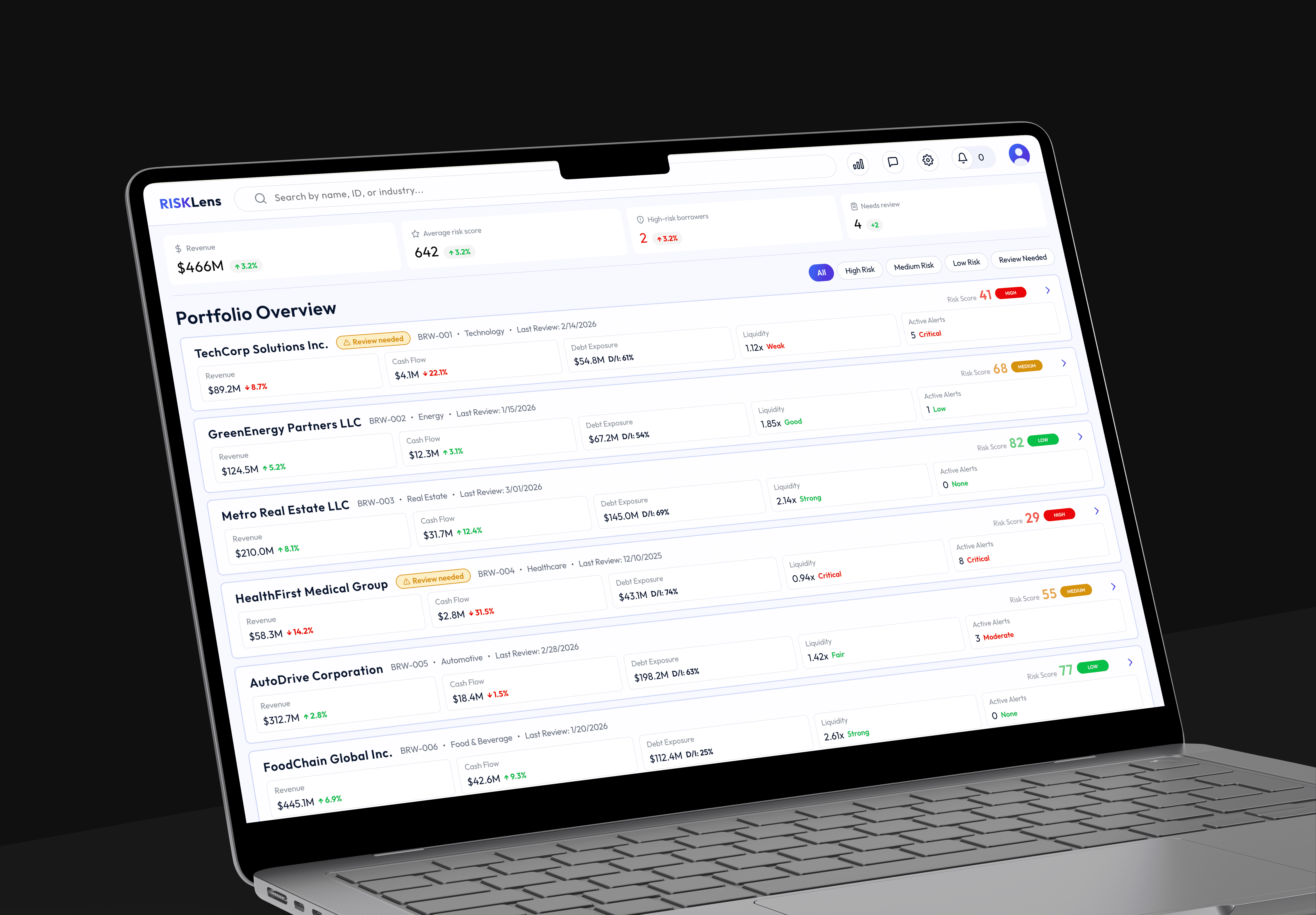
Most fintech risk analysis tools bury critical signals under overwhelming data layers, forcing analysts to hunt for insights instead of making confident decisions.
——-
I designed a scannable risk workflow that prioritizes key signals through information hierarchy and progressive disclosure, then used AI-assisted development to turn Figma designs into production code and ship a responsive SaaS product in 2 weeks.
The problem
Most risk analysis tools in fintech are hard to skim. Large amounts of financial data need to be understood quickly, but the interfaces make it overwhelming.
.
.
Key challenge
User context
Risk analysts review multiple borrowers regularly to monitor financial health and identify potential risk.
They need to
01
Scan portfolios fast
02
Spot high-risk accounts immediately
03
Investigate why a borrower is risky
04
Decide whether to monitor, review, or escalate
Execution framework
.
Research
Studied similar SaaS tools to understand what risk analysts actually need to see first.
Design principles
Prioritize risk visibility
Support fast scanning
Progressive disclosure
Keep the interface calm

Sketch

Screenshot of the rejected AI-generated layout from Stitch

low-fi Figma wireframe

hi-fi Figma screen
04
Vibe Coding with AI
Connected Figma to Claude Code and built it in React, page by page. It took several iterations to get right, and along the way my prompting and use of tokens got sharper.
Early prompt

I went from designer
to design critic.
Refined prompt

05
Shipping It

→

→

→

The solution
01
Portfolio Overview
Goal
Help analysts quickly identify which borrowers need attention.
Key Elements
Card layout for side-by-side comparison
Risk score and status clearly visible
Key financial indicators summarized
Alerts and "Review needed" status highlighted
Outcome:
Analysts can scan the portfolio in seconds and prioritize their work.
02
Risk Analysis Workspace
Problem
Help analysts understand why a borrower is at risk.
Key Elements
Prominent risk score with status indicator
Financial health summary (revenue, cash flow, debt, liquidity)
Performance trends across multiple periods
Active alerts highlighting risk drivers
Structured tabs for deeper analysis
Context panel with notes, covenants, and documents
Outcome:
A clear, decision-focused workflow that enables analysts to quickly identify high-risk borrowers and confidently investigate the drivers behind financial risk.
What I Learned
Prompt engineering is a design skill
AI accelerated execution, not decisions
Design system first, before any screen
Shipped in 2 weeks, research to deployed product.
-
